


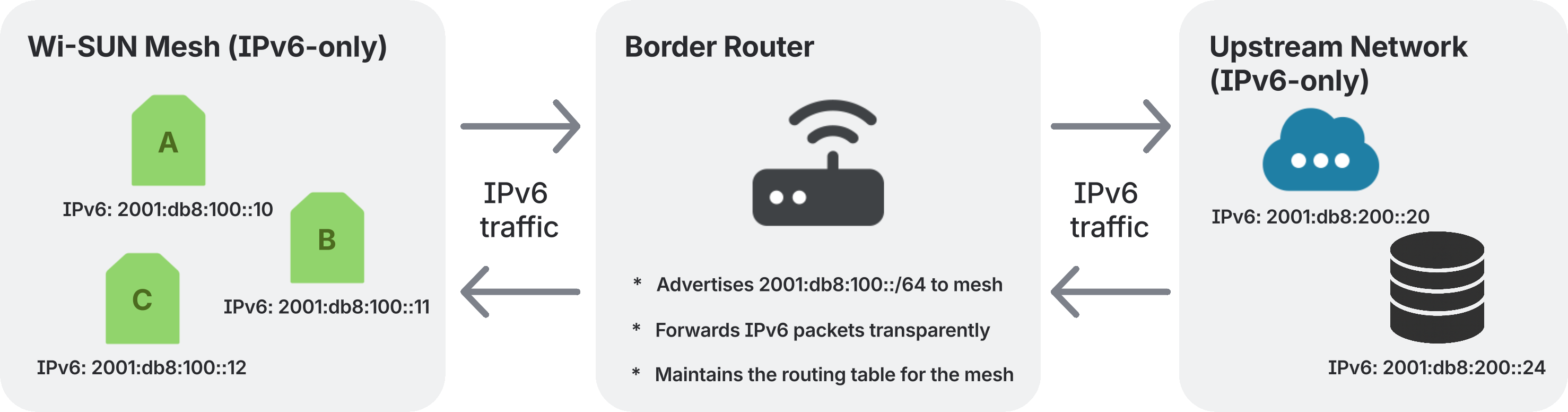
In the Routed prefix model, the Wi-SUN Border Router advertises an IPv6 prefix into the mesh and routes traffic between the Wi-SUN network and the upstream IP network. Each device forms its link-local address from its unique EUI-64 identifier and obtains its global IPv6 address from the Border Router using DHCPv6. This ensures all addresses are unique and routable.
This model provides full end-to-end IPv6 connectivity — every Wi-SUN node is directly addressable, and traffic is routed (not translated or proxied) between the Wi-SUN mesh and the external IP network. It represents the “true IPv6” deployment model for Wi-SUN networks and serves as the basis for two addressing approaches:
-
Prefix delegation (DHCPv6-PD): The Border Router requests a prefix from an upstream delegating router and distributes addresses within the Wi-SUN mesh.
-
Static prefix assignment: The Border Router is manually configured with a fixed IPv6 prefix, from which nodes derive their addresses.
When to use
Choose Routed prefix if:
-
The upstream network supports IPv6 natively.
-
End-to-end IPv6 connectivity between field devices and external systems is required.
-
The network should avoid translation or proxy layers for simpler, standards-based routing.
-
You want flexibility to scale using either dynamic (delegated) or static prefix management.
-
The network is expected to be large (e.g., >200 nodes) or grow/change dynamically. Large numbers of nodes are deployed, requiring structured, hierarchical address allocation.
Behavior
Regardless of how the prefix is obtained (delegated or static), the routed model behaves consistently:
-
The Border Router advertises the IPv6 prefix into the Wi-SUN mesh.
-
Each node automatically configures a link-local address (fe80::/10) using its unique EUI-64 identifier and then obtains a global or unique-local IPv6 address (GUA/ULA) through DHCPv6 via the Border Router.
-
The Border Router maintains routing for all nodes and forwards traffic to and from the upstream network.
-
Communication is IPv6 end-to-end — no translation, bridging, or NAT occurs.
Pros and cons
-
Pros
-
Enables globally routable IPv6 connectivity for all devices.
-
Clean integration with modern IP infrastructure.
-
Flexible: works with either dynamic (Prefix delegation) or manual (Static prefix) addressing.
-
Scales naturally when properly planned with unique prefixes per Border Router.
-
Avoids translation overhead, improving performance.
-
-
Cons
-
Requires native IPv6 upstream support.
-
Greater exposure of devices to upstream networks; security controls must be in place.
-
Prefix management (especially across multiple Border Routers) must be well coordinated.
-
Address assignment
This model can use the Border Router’s built-in DHCPv6 service, known as BR-local DHCPv6 or the DHCPv6 relay approach.
BR-local DHCPv6 refers to the Border Router’s built-in DHCPv6 service, which assigns IPv6 addresses directly to Wi-SUN nodes within its PAN. In this mode, the Border Router acts as the DHCPv6 server for the entire mesh, managing address allocation locally and independently of any upstream infrastructure.
The Border Router:
-
Assigns IPv6 addresses to all nodes in the Wi-SUN network.
-
Maintains its own address pool, typically derived from a static prefix or a delegated prefix obtained via DHCPv6-PD.
-
Handles all DHCPv6 requests locally — no relay or upstream coordination is required.
-
Operates autonomously, ensuring address assignment even if the upstream connection becomes unavailable.
For example, if the Border Router is assigned the prefix 2001:db8:100::/64:
-
It runs a local DHCPv6 service.
-
Wi-SUN nodes request addresses via DHCPv6.
-
The Border Router assigns addresses such as:
-
2001:db8:100::10 -
2001:db8:100::11 -
and so on.
-
All communication remains within this prefix, allowing the Border Router to manage and route all local traffic effectively.
The key advantages of this approach are:
-
Self-contained operation: No dependency on upstream DHCPv6 servers.
-
Faster provisioning: Address assignment happens locally.
-
Resilience: The network continues to operate even during temporary upstream outages.
-
Simplicity: Ideal for smaller or standalone Wi-SUN deployments.
DHCPv6 relay is a mechanism in which the Border Router forwards address assignment requests from Wi-SUN nodes to an upstream DHCPv6 server. Instead of managing addresses locally, the Border Router acts as a relay agent, integrating the Wi-SUN mesh into a centrally managed IPv6 network.
The Border Router:
-
Relays DHCPv6 requests from Wi-SUN nodes to an upstream DHCPv6 server, such as one in an enterprise or provider network.
-
Receives the responses from the upstream server and forwards them back to the requesting Wi-SUN nodes.
-
Does not maintain its own address pool; all addressing decisions are handled centrally by the upstream infrastructure.
-
Integrates the Wi-SUN mesh into a broader, centrally managed IPv6 network.
For example, if the upstream DHCPv6 server manages the prefix 2001:db8:100::/64:
-
The Border Router relays DHCPv6 messages from Wi-SUN nodes to the upstream server.
-
The upstream server allocates addresses under that prefix and returns them through the Border Router.
-
Each Wi-SUN node receives a globally unique IPv6 address, such as:
-
2001:db8:100::10 -
2001:db8:100::11 -
and so on.
-
All address management, lease control, and prefix distribution are handled upstream, ensuring consistent policy and coordination across multiple Border Routers.
The key advantages of this approach are:
-
Centralized management: A single DHCPv6 server can coordinate addressing across many Border Routers or sites.
-
Scalability: Simplifies large deployments by avoiding local address pools on each Border Router.
-
Consistency: Enables unified prefix planning and monitoring under enterprise or service provider policies.
-
Integration: Fits naturally into existing DHCPv6-managed infrastructure.
Considerations
Routed prefix brings these operational considerations:
-
Prefix allocation: Each Border Router must operate with a unique IPv6 prefix to avoid overlap. In delegated mode, prefixes stability must be managed to ensure long or static assignments; in static mode, they are manually assigned.
-
Routing and security: Devices are directly reachable from external networks, so proper routing and firewal rules are essential.
-
Prefix size: Use a /64 prefix to maintain compatibility with IPv6 autoconfiguration and to support future scaling.
In case you have an address assignment authority preference:
-
If central IT wants control over addressing, use DHCPv6 relay to upstream DHCP.
-
If an autonomous Border Router is acceptable, use the Border Router’s local DHCPv6 (with DAD, randomized/stable addresses), or PD + local DHCPv6 if PD is available.
