


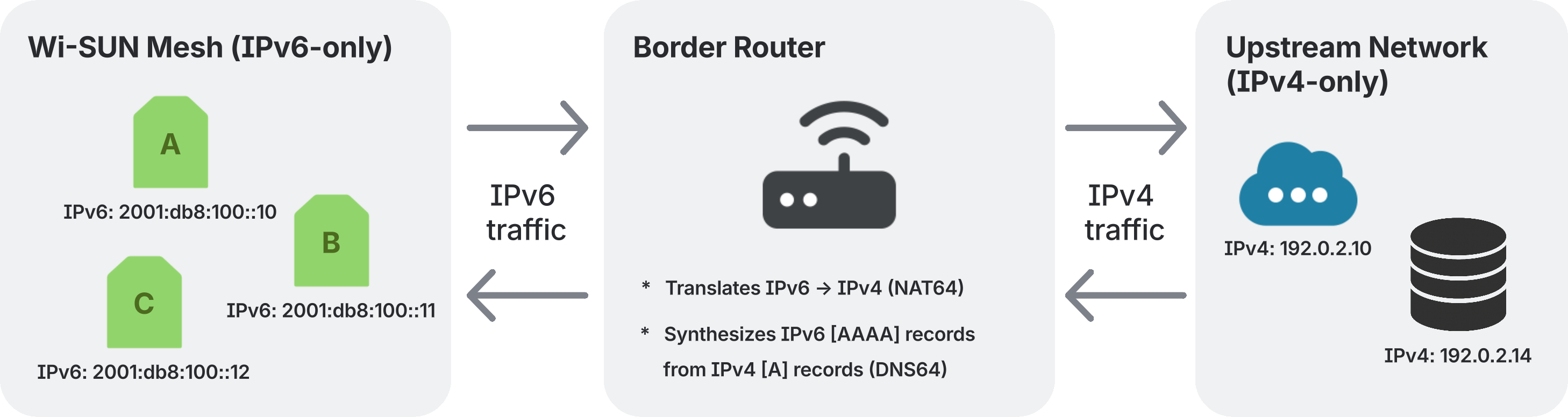
The NAT64/DNS64 translation model allows IPv6-only Wi-SUN devices to access IPv4-based services by dynamically translating traffic between the two protocols. The Border Router handles the packet translation (NAT64), while DNS64 synthesizes IPv6 (AAAA) records from IPv4 (A) records so devices can reach legacy services transparently through standard DNS resolution.
This model is particularly useful in environments where IPv6 adoption is incomplete but devices must still connect to existing IPv4 applications or infrastructure.
When to use
Choose NAT64/DNS64 translation if:
-
The upstream network or applications are IPv4-only.
-
Devices in the Wi-SUN mesh must reach legacy cloud or enterprise services without native IPv6 support.
-
You want to extend an IPv6-based Wi-SUN deployment into an IPv4-centric environment with minimal configuration changes.
-
You have one or more Border Routers.
This model scales well from small test networks to large multi-Border Router deployments and offers a flexible bridge between modern Wi-SUN meshes and existing IPv4 infrastructure.
Pros and cons
-
Pros
-
Seamlessly connects IPv6-only devices with IPv4 services.
-
DNS64 allows applications to continue using domain names without modification.
-
Requires no changes to upstream IPv4 applications or infrastructure.
-
Provides a standards-based transition strategy while IPv6 is gradually adopted.
-
-
Cons
-
Translation adds overhead, which can affect performance in latency-sensitive use cases.
-
Troubleshooting becomes more complex because device addresses are obscured by translation.
-
Limited visibility into the original IPv6 source may complicate logging and security monitoring.
-
Address assignment
This model uses the Border Router’s built-in DHCPv6 service, known as BR-local DHCPv6.
BR-local DHCPv6 refers to the Border Router’s built-in DHCPv6 service, which assigns IPv6 addresses directly to Wi-SUN nodes within its PAN. In this mode, the Border Router acts as the DHCPv6 server for the entire mesh, managing address allocation locally and independently of any upstream infrastructure.
The Border Router:
-
Assigns IPv6 addresses to all nodes in the Wi-SUN network.
-
Maintains its own address pool, typically derived from a static prefix or a delegated prefix obtained via DHCPv6-PD.
-
Handles all DHCPv6 requests locally — no relay or upstream coordination is required.
-
Operates autonomously, ensuring address assignment even if the upstream connection becomes unavailable.
For example, if the Border Router is assigned the prefix 2001:db8:100::/64:
-
It runs a local DHCPv6 service.
-
Wi-SUN nodes request addresses via DHCPv6.
-
The Border Router assigns addresses such as:
-
2001:db8:100::10 -
2001:db8:100::11 -
and so on.
-
All communication remains within this prefix, allowing the Border Router to manage and route all local traffic effectively.
The key advantages of this approach are:
-
Self-contained operation: No dependency on upstream DHCPv6 servers.
-
Faster provisioning: Address assignment happens locally.
-
Resilience: The network continues to operate even during temporary upstream outages.
-
Simplicity: Ideal for smaller or standalone Wi-SUN deployments.
Considerations
NAT64/DNS64 translation introduces several operational aspects to plan for:
-
DNS reliance: Clients must either know how to construct IPv6-translated addresses manually or rely on DNS64 to perform this translation automatically through standard DNS queries.
-
Security policies: Firewalls and ACLs must be carefully designed, since translation can mask true device identity.
-
Performance testing: Latency and throughput should be validated in advance, especially for time-sensitive protocols.
-
Transition model: NAT64/DNS64 should be considered a strategy for environments migrating gradually to full IPv6 capability.
