


Digi’s Wi-SUN solution enables the creation of secure, large-scale mesh networks based on open standards. It provides a reliable framework for connecting distributed devices over IPv6, making it suitable for industrial, utility, and smart-city applications.
Overview
Digi’s solution implements the Wi-SUN FAN (Field Area Network) standard to build large-scale, IPv6-based mesh networks that are secure, resilient, and interoperable.
A Wi-SUN deployment combines Border Routers and Wi-SUN nodes into a dynamic mesh that adapts to environmental conditions and device availability.
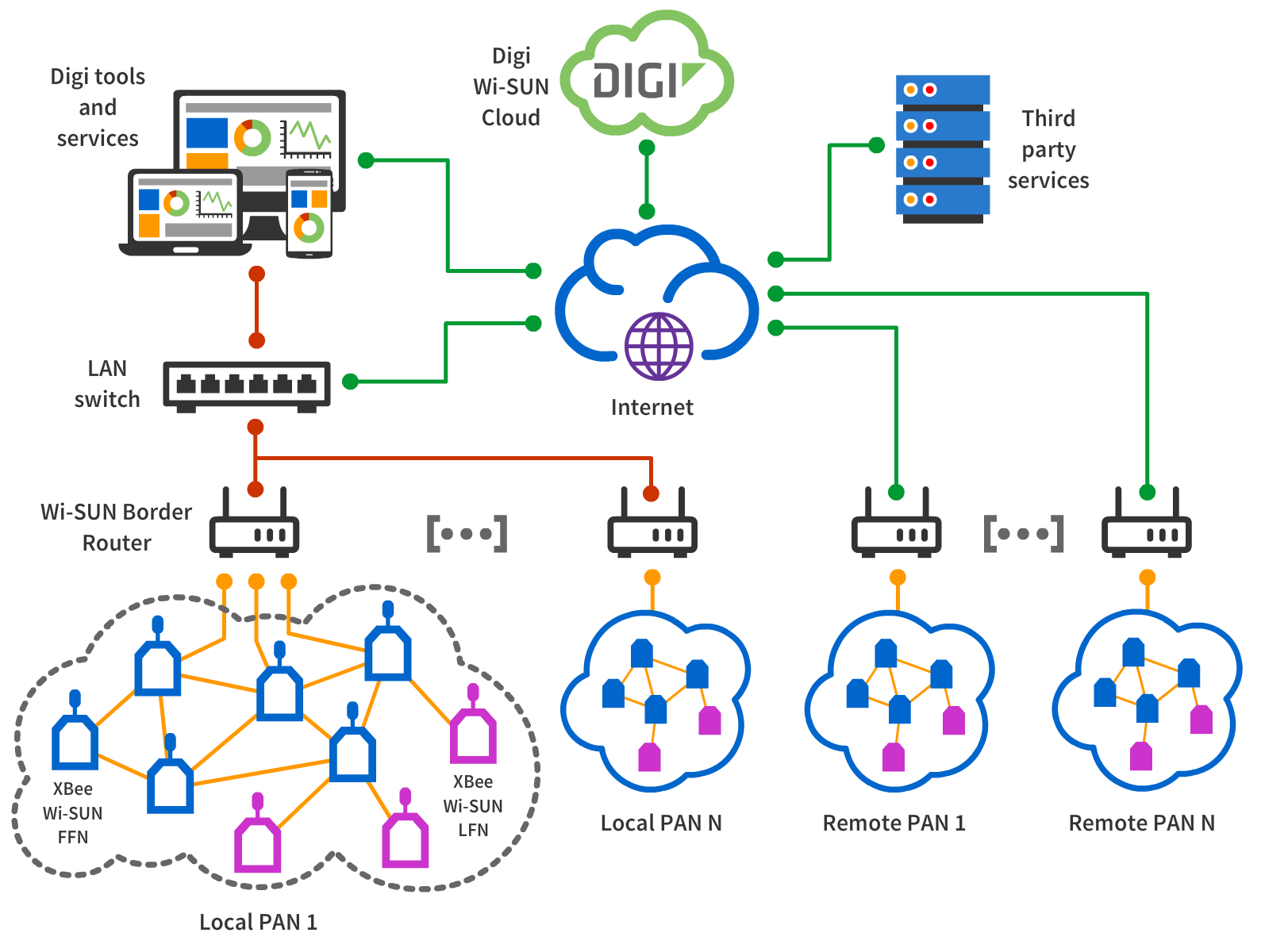
The diagram above illustrates the overall architecture of a Digi Wi-SUN deployment. At a high level, it consists of the following elements:
-
Border Router: Acts as the network root and gateway. It forms and manages the Personal Area Network (PAN), authenticates devices, and routes data between the mesh and external IP networks such as Ethernet, cellular, or Wi-Fi.
-
Full Function Nodes (FFNs): Mesh routers that relay data across multiple hops, extending coverage and building redundancy.
-
Limited Function Nodes (LFNs): Endpoint devices that generate or consume data but do not forward traffic for others.
-
External Networks and Services: Upstream communication enables integration with Digi Remote Manager, local servers, or cloud-based analytics.
Each PAN operates independently yet can interconnect with others through IP routing or VPN tunneling, creating wide-area, distributed Wi-SUN systems. This architecture ensures end-to-end IPv6 communication using familiar transport protocols such as UDP and TCP, supporting seamless interoperability with standard IP infrastructure.
The following topics introduce the key concepts, components, and mechanisms that define how Digi’s Wi-SUN solution operates:
