


In some cases, the XBee device is used as a wireless (RF or Cellular) interface enabler and the intelligence of the device resides in an external micro-controller.
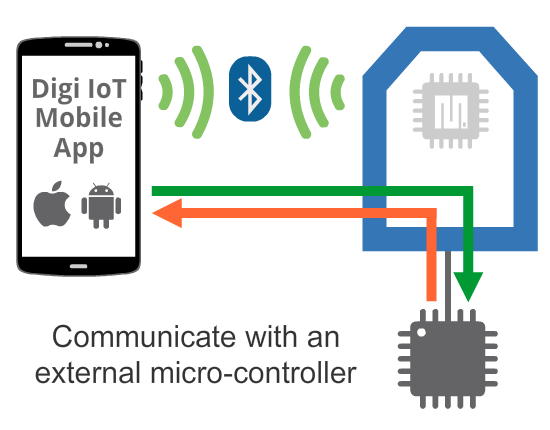
In this case, the purpose of the Bluetooth Low Energy (BLE) interface is to communicate with the external micro-controller, forwarding the data sent from the mobile device to the serial interface of the XBee device and vice-versa. This use case is similar to the MicroPython one.
For this use case, you’ll need a mobile application running on the mobile phone and another application running in the external micro-controller. This last application can be developed using any of the XBee libraries that Digi provides.
| For more information about the XBee libraries, see XBee Java Library and XBee Python Library. |
See the scenarios below for ways to communicate with an external micro-controller via BLE:
-
Perform a device provisioning operation (initial configuration) of XBee devices during the network deployment process. This includes XBee firmware parameters and other settings stored in the external micro-controller.
-
Read diagnostic information from XBee devices already deployed in a network.
-
Read transformed values from peripherals connected to the XBee device or to the external micro-controller or command actions to it.
-
Provide a graphic UI for the product or system using the mobile phone screen as the interface.
-
Transfer files to the external micro-controller or update its firmware over-the-air.
Example
The Digi IoT Mobile SDK includes an example that demonstrates how a mobile application can communicate via BLE with an external micro-controller connected to the XBee device. The example shows you how to send a file from the mobile application and receive it in the micro-controller connected to the XBee device.
| Smartphone side | External micro-controller side |
|---|---|
