Factors affecting wireless communication
Although the communication distance specified for some XBee devices can be up to 25 miles or more, this value may be affected by factors that may decrease the quality of the signal:
- Some materials can reflect the radio frequency waves, causing interference with other waves and loss of signal strength. In particular, metallic or conductive materials are great reflectors, although almost any surface can reflect the waves and interfere with other radio frequency waves.
- Radio waves can be absorbed by objects in their path, causing loss of power and limiting transmission distance.
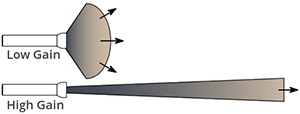
- Antennas can be adjusted to increase the distance that data can travel in a wireless communication system. The more focus the antenna can apply, the more range the system will yield. High-gain antennas can achieve greater range than low-gain antennas, although they cover less area.
A flashlight can help illustrate the principle. Some flashlights allow the user to adjust the beam of light by twisting the lens to focus or spread the beam of light. When the lens spreads—or diffuses—the beam of light, that beam of light travels a shorter distance than when the lens is twisted to focus the beam of light.
- Line-of-sight can help increase reliability of the signal.
To achieve the greatest range, the football-shaped path in which radio waves travel (Fresnel zone) must be free of obstructions. Buildings, trees, or any other obstacles in the path will decrease the communication range. If the antennas are mounted just off the ground, over half of the Fresnel zone ends up being obstructed by the curvature of the earth, resulting in significant reduction in range. To avoid this problem, mount the antennas high enough off the ground that the earth does not interfere with the central diameter of the Fresnel zone.

 PDF
PDF


