Distance and obstacles
Basic communication systems involve the following components:
- Transmitting element
- Receiving device
- Environment through which communication is occurring
- Antennas or other focusing elements
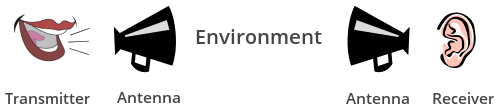
RF communication can be compared to simple audio communication: our vocal cords transmit sound waves that may be received by someone's eardrum. We can use a megaphone to focus and direct the sound waves in order to make the communication more efficient.
The transmitter's role in wireless communication is to feed a signal to an antenna for transmission. A radio transmitter encodes data in RF waves with a certain signal strength (power output) to project the signal to a receiver.
The receiver gets and decodes data that comes through the receiving antenna. The receiver performs the task of accepting and decoding designated RF signals while rejecting unwanted ones.
Antennas are devices that focus energy in a particular direction, similar to the way the megaphone focuses voice energy. Antennas can provide different radiation patterns depending on the design and application. How much the energy is focused in a given direction is referred to as antenna gain.
The space between the transmitter and receiver is the system's environment. Attaining RF line-of-sight (LOS) between sending and receiving antennas is essential to achieving long range in wireless communication. There are two types of LOS that are generally used to describe an environment:
- Visual LOS is the ability to see from one site to the other. It requires only a straight linear path between two points.
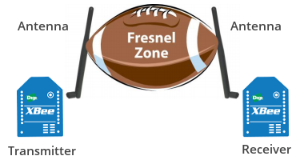
- RF LOS requires not only visual LOS, but also a football-shaped path called a Fresnel zone that is free of obstacles so data can travel optimally from one point to another. The Fresnel zone can be thought of as a tunnel between two sites that provides a path for RF signals.
 PDF
PDF


